

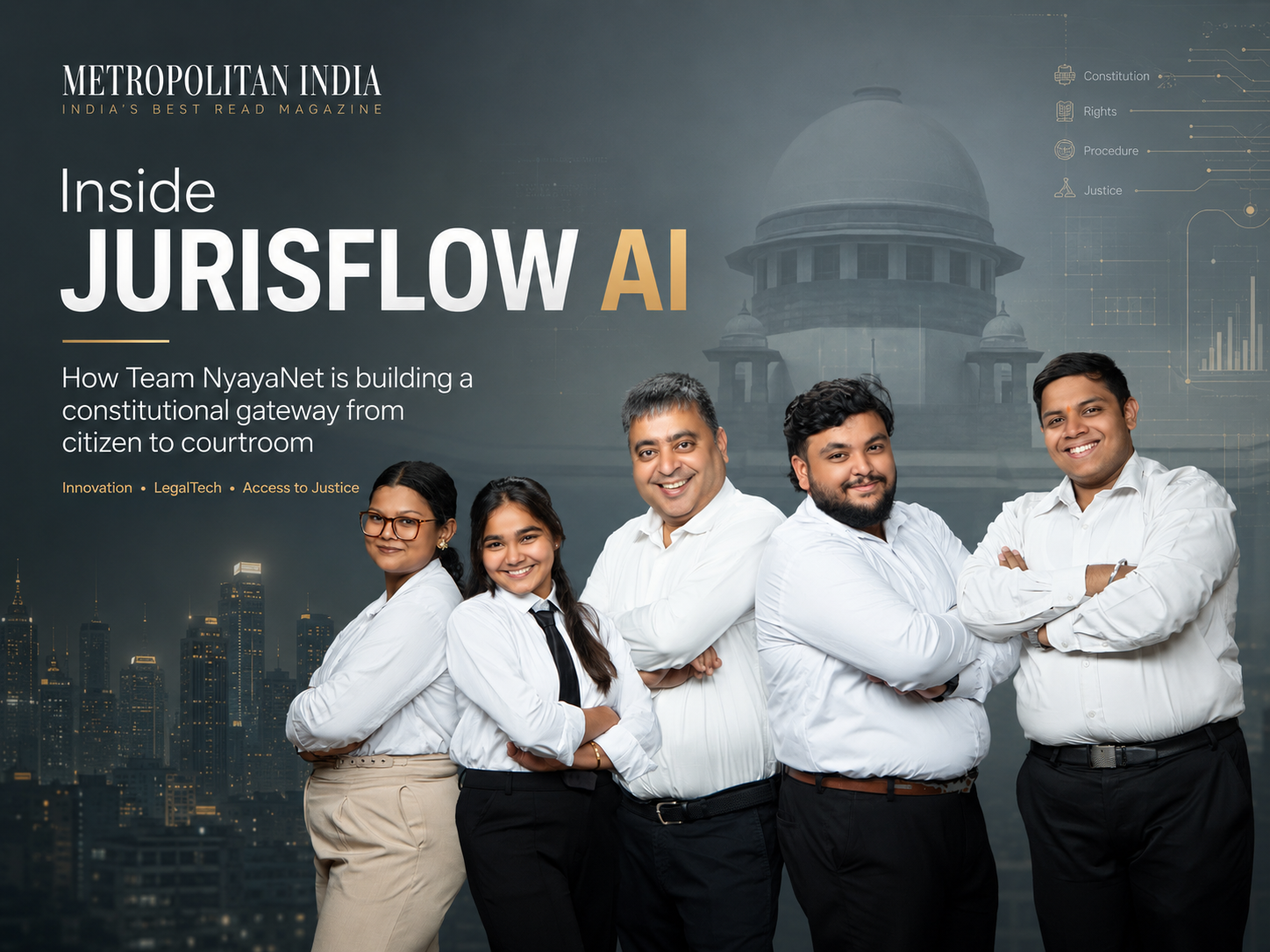

Created by the Brilliant Minds of Brainware, the LegalTech prototype combines multilingual access, AI-assisted drafting, secure workflows, predictive research and human supervision in an ambitious effort to strengthen equality and access to justice in India.
India has built digital infrastructure capable of transforming identity, payments, documentation and public services. Yet for millions of citizens, the journey from grievance to courtroom remains complicated by language, legal procedure, cost, geography and limited digital literacy.
At Brainware University’s Barasat campus in West Bengal, Team NyayaNet has developed JURISFLOW AI, a multilingual, voice-first and auditable LegalTech prototype designed to support the path from citizen grievance to legal research, drafting and filing preparation.
The team comprises:
Raja Mukherjee – Team Lead and Mentor
Sayantani Mukherjee
Harshdeep Kaur
Bhaswati Roy
Sabyasachi Dasgupta
Tushan Rajbanshi
Collectively recognised as The Brilliant Minds of Brainware, the six-member team has framed JURISFLOW AI around a larger social cause: protecting India’s constitutional promise of equality, dignity, fair procedure and justice for all.
A Constitutional Starting Point
Many artificial-intelligence projects begin by asking what technology can automate.
Team NyayaNet began with a different question: how can technology assist the justice system without weakening judicial sovereignty, human responsibility or constitutional rights?
JURISFLOW AI is therefore not presented as an artificial judge. It is not intended to issue binding decisions or replace advocates and courts.
Its role is preparatory and assistive.
The platform proposes to help citizens explain grievances, structure facts, identify potentially relevant legal provisions and prepare initial legal drafts. For advocates, it offers research, drafting, document organisation and case-management support. For institutions, it proposes workflow visibility, secure access and audit records.
Final legal responsibility remains human and institutional.
From Citizen Voice to Legal Draft
The citizen-facing process begins with voice.
A person may describe a grievance in an Indian language rather than completing a complex legal form. The system attempts to transcribe the account, preserve the original narration, organise the facts and identify the possible cause of action, jurisdiction and forum.
Its legal mapping environment refers to India’s newer criminal-law framework, including the Bharatiya Nyaya Sanhita, Bharatiya Nagarik Suraksha Sanhita and Bharatiya Sakshya Adhiniyam.
JURISFLOW AI can then prepare an initial complaint, petition or reply for human review.
The project’s voice-first model is important because legal exclusion often begins before a citizen reaches court. A right may formally exist, but remain difficult to exercise when a person cannot communicate in the language or format expected by the institution.
Human-in-the-Loop Protection
The platform’s most important safeguard is its Human-in-the-Loop Checkpoint.
Before an irreversible action such as filing, payment or retrieval of an official record, the system must present its proposed step to an authorised human user.
The user may approve, modify or reject it.
This distinction separates assistive technology from autonomous institutional power. An AI model may misunderstand facts, generate an incorrect citation or fail to recognise linguistic and cultural context. Human review creates an opportunity to identify such errors before they become official acts.
For Team NyayaNet, human supervision is not merely an engineering feature. It is part of the project’s constitutional design.
The Four-Layer Architecture
JURISFLOW AI is structured across four principal layers.
The first is the frontend, containing interfaces such as the Command Centre, Filing Hub and Qwen Autopilot Panel. These allow citizens, advocates and authorised institutional users to manage matters and review AI-proposed actions.
The second layer uses Supabase Edge Functions as a controlled trust boundary. It manages authentication, permissions, voice-to-draft processing and communication between the frontend, databases and AI services.
The third layer contains the data and AI environment. The architecture refers to Supabase Postgres, Row-Level Security and Qwen models for drafting, summarisation and reasoning. Role-based controls are intended to ensure that citizens, advocates and institutional users see only the records they are authorised to access.
The fourth layer represents proposed connections to systems such as CCTNS, e-Courts services, UPI court-fee payments and DigiLocker or Aadhaar-linked verification.
These external integrations remain proposed and would require official permission, regulatory review and independent security validation.
Why Federation Matters
India’s judicial environment includes the Supreme Court, 25 High Courts, district courts, tribunals and multiple state-level systems.
JURISFLOW AI therefore adopts a federated philosophy rather than unrestricted centralisation.
Under the proposed model, institutions would retain control over their own records while limited, privacy-protected updates or hashes could move through the wider network.
Federation is presented not only as a technology decision, but also as a way of respecting institutional sovereignty and citizen data protection.
Impact Factor: Challenging the Existing LegalTech Market
India’s LegalTech market includes research databases, case-management tools, drafting applications, e-filing assistance and generative-AI products. Most solutions, however, focus on one part of the legal workflow.
JURISFLOW AI challenges this fragmented model by proposing one connected environment for citizen intake, legal classification, precedent research, drafting, matter management, filing preparation and audit.
Its competitive proposition is not simply another legal chatbot.
It is the attempted integration of citizen access, professional legal intelligence and institutional management within a multilingual and human-supervised architecture.
Supreme Court and High Court Precedent Research
A major component of the project’s impact proposition is its planned legal-research environment spanning the Supreme Court of India and all 25 High Courts.
The prototype materials refer to more than 2,600 Supreme Court and High Court judgments currently incorporated into its research environment. The larger vision is to include approximately 30 years of precedent judgments within a structured and continuously governed legal corpus.
For legal professionals, the value could extend beyond conventional keyword search.
A connected research environment could help advocates trace how doctrines evolved, identify controlling Supreme Court authorities, compare High Court interpretations and understand whether a judgment has been followed, distinguished or questioned.
Instead of beginning only with a known case name or citation, professionals could potentially begin with the facts and issues of a matter. The system could then surface relevant statutes, precedent chains and comparable factual patterns for human assessment.
Predictive Analytics for Legal Planning
JURISFLOW AI also proposes predictive analytics for cases that have not yet been filed or remain undecided.
This should not be interpreted as predicting a judicial decision with certainty. Outcomes depend on evidence, procedure, advocacy and the independent reasoning of the court.
Its more responsible use would be to identify patterns, risks and strategic considerations.
Before filing a matter, a lawyer or corporate legal team could examine jurisdiction, common preliminary objections, evidentiary gaps, procedural delays and the possible value of mediation, arbitration or settlement.
For a pending case, the platform could help identify conflicting authorities, missing documents, deadlines and patterns across comparable disputes.
Used carefully, predictive analytics could help legal professionals determine whether to file, which forum to approach, what evidence to secure and how much cost and specialist involvement a matter may require.
It would support professional judgment, not replace it.
The Command Centre as a Legal Management System
The JURISFLOW AI Command Centre also introduces a proposed Legal Management System for institutions, law firms and large corporations.
Legal departments frequently manage matters through disconnected spreadsheets, email chains, document folders and external-counsel updates. This fragmentation can make it difficult to track the status, cost, deadline, responsible professional and risk associated with each dispute.
The Command Centre is intended to provide one role-controlled view of:
- Active litigation and pre-litigation disputes
- Notices, pleadings, evidence and hearing dates
- Internal teams and external advocates
- Legal research and opinions
- Expenditure and court-fee records
- Compliance actions and risk priorities
- AI-generated drafts and human approvals
Such integration could reduce risk by identifying urgent matters and approaching deadlines.
It could control cost by reducing duplicated research and repetitive drafting.
It could also improve resource deployment by assigning lawyers, experts and external counsel according to the complexity and risk of each matter.
For large corporate legal departments, this could move legal operations from a reactive function towards a more measurable management discipline.
The Development Path
Team NyayaNet’s proposed roadmap begins with pilot engagement involving two High Courts and approximately 200 advocate firms.
Later stages envision expansion across High Courts and selected district courts, followed by proposed Supreme Court e-filing and cause-list integration.
These are development objectives, not current institutional deployments.
Progress would require judicial approval, regulatory scrutiny, cybersecurity testing, funding and independent validation.
Technology in Service of the Constitution
JURISFLOW AI remains a prototype-stage initiative, and its larger claims and integrations must be tested independently.
Yet the project introduces an important direction for Indian innovation.
It treats access to justice as a language, technology, management and constitutional challenge at the same time.
It places human approval before automation.
It proposes auditable processes instead of blind trust.
It favours federation over unrestricted centralisation.
And it frames artificial intelligence as an assistant to legal professionals and institutions rather than an authority above them.
For Raja Mukherjee, Sayantani Mukherjee, Harshdeep Kaur, Bhaswati Roy, Sabyasachi Dasgupta and Tushan Rajbanshi, JURISFLOW AI is an attempt to connect innovation with public responsibility.
A citizen speaks.
The system organises the grievance.
Artificial intelligence prepares a draft.
A human reviews the action.
And final authority remains where the Constitution places it.
That is not justice by machine.
It is an attempt to make the path towards justice more equal, comprehensible and accountable.